
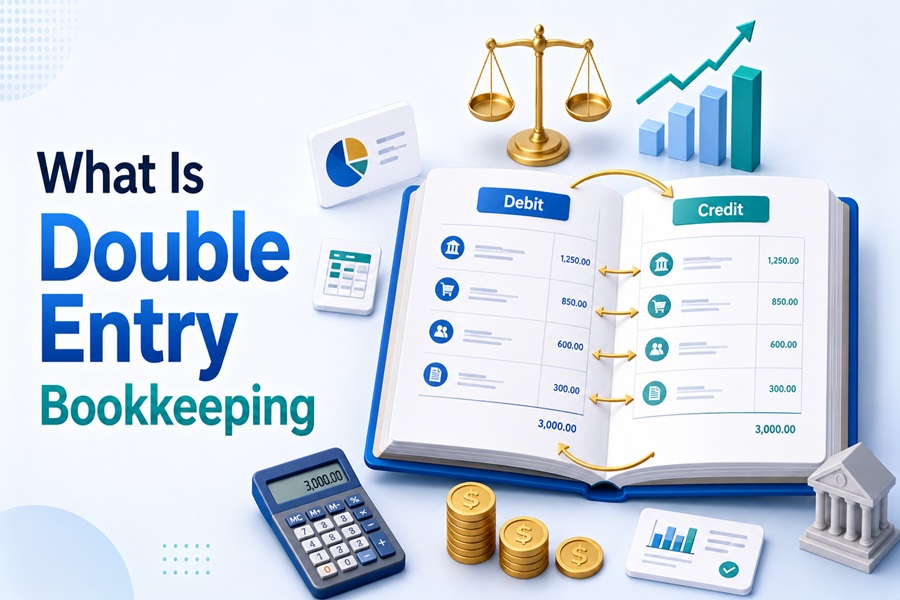
Quick answer: Double entry bookkeeping is an accounting method where every transaction is recorded in at least two accounts, with one entry as a debit and one as a credit. The total debits must always equal the total credits, which keeps the books in balance. It rests on the accounting equation, Assets equal Liabilities plus Equity, and it is the standard system for businesses because it catches errors and gives a complete financial picture. The method is roughly five centuries old and still underpins modern accounting software.
Here is how it works, what debits and credits really mean, and clear examples that make it click.
What does “double entry” actually mean?
Every business transaction has two sides. Money or value moves from one place to another, so it must be recorded twice.
One account is debited. Another is credited. The two entries are equal and opposite, which is why the system is called double entry.
For example, if a business borrows money, cash goes up and debt goes up by the same amount. Both sides get recorded, and the books stay balanced.
What is the accounting equation?
Double entry is built on one foundational rule:
Assets = Liabilities + Equity
Every transaction keeps this equation in balance. If it does not balance, there is a mistake in the books.
That is the whole point. The equation is a built-in error check that runs on every single entry.
What are debits and credits?
This is where beginners get stuck, so keep it simple. In accounting, debit and credit do not mean “good” and “bad” or “in” and “out.”
- A debit is an entry on the left side of an account.
- A credit is an entry on the right side of an account.
That is it. Whether a debit increases or decreases an account depends on the type of account, which brings us to the one rule that unlocks everything.
The one rule that makes debits and credits easy
Group the five account types by their normal balance. Once you know the account type, you always know which way to go.
| Account type | Normal balance | Debit does | Credit does |
|---|---|---|---|
| Assets | Debit | Increases | Decreases |
| Expenses | Debit | Increases | Decreases |
| Liabilities | Credit | Decreases | Increases |
| Equity | Credit | Decreases | Increases |
| Revenue | Credit | Decreases | Increases |
The shortcut: assets and expenses grow with debits. Liabilities, equity, and revenue grow with credits. To shrink any account, use the opposite side.
A common myth: a debit does not mean money is leaving. Debiting cash actually increases your cash, because cash is an asset.
What is a T-account?
Before software, bookkeepers used T-accounts to picture how entries moved. They are still the clearest way to learn.
A T-account looks like the letter T. The account name sits on top. Debits go on the left, credits on the right. At a glance you can see the balance.
If a transaction ever confuses you, sketching the T-accounts on paper usually makes the answer obvious.
Worked examples that make it click
Seeing it in action beats memorizing rules. Here are common transactions and how each is recorded.
| Transaction | Debit | Credit |
|---|---|---|
| Borrow $10,000 from the bank | Cash (asset) $10,000 | Loans payable (liability) $10,000 |
| Buy a $1,000 laptop with cash | Equipment (asset) $1,000 | Cash (asset) $1,000 |
| Sell a product for $200 cash | Cash (asset) $200 | Revenue $200 |
| Pay $500 rent | Rent expense $500 | Cash (asset) $500 |
Notice the pattern. In every row, debits equal credits. The books balance on every transaction.
Take the loan example. Cash goes up, so you debit the asset. Debt goes up, so you credit the liability. Both sides of the accounting equation rise by the same amount, and it stays balanced.
How is double entry different from single entry?
Single entry is the simpler cousin, and it has real limits.
| Feature | Single entry | Double entry |
|---|---|---|
| Records per transaction | One | Two or more |
| Uses debits and credits | No | Yes |
| Error detection | Weak | Strong, built in |
| Financial picture | Partial | Complete |
| Best for | Personal or very small tracking | Most businesses |
Single entry works like a check register, tracking only what comes in and goes out. Double entry gives the full picture and is the standard for any real business.
Why does double entry matter?
The benefits are the reason it has lasted five centuries.
- Accuracy. The balance rule flags mistakes the moment the books stop balancing.
- Fraud detection. Equal and opposite entries make manipulation harder to hide.
- Complete picture. It tracks assets, liabilities, equity, revenue, and expenses together.
- Financial statements. It feeds directly into the income statement, balance sheet, and cash flow statement.
- Scalability. As transactions multiply, ledgers and software automate the tracking.
What do learners and bookkeepers say?
Community experience adds helpful context for anyone starting out.
- On Reddit, accounting learners repeatedly say the breakthrough comes from memorizing account types and their normal balances, not from memorizing individual transactions.
- On Quora, bookkeepers stress that the “debit means money out” confusion is the single biggest beginner trap, and that unlearning the bank’s meaning of the words is step one.
- On Medium, practitioners recommend drawing T-accounts by hand until the logic becomes automatic, even in a software-driven world.
The shared lesson: learn the account types, drop the everyday meaning of the words, and practice with T-accounts.
Debit and credit are directions, not values. They simply mean left and right. Whether an entry helps or hurts an account depends entirely on the account type. Once that clicks, the whole system stops feeling arbitrary.
The balance rule is a free error checker. Because debits must equal credits and the accounting equation must hold, the system tells you immediately when something is wrong. That built-in self-check is the real genius of the method, and why it has outlived every alternative.
Frequently asked questions
What is double entry bookkeeping in simple terms?
It is recording every transaction twice, once as a debit and once as a credit, so the books always balance and errors show up fast.
Does a debit always mean money is leaving?
No. Debiting an asset like cash increases it. Debit just means the left side of an account.
What is the accounting equation?
Assets equal Liabilities plus Equity. Every transaction keeps this equation in balance.
Do small businesses need double entry?
Most do. It gives an accurate, complete financial picture and catches errors, which single entry cannot. Modern software handles the mechanics automatically.
How do I remember debits and credits?
Assets and expenses increase with debits. Liabilities, equity, and revenue increase with credits. Identify the account type and you always know which side to use.