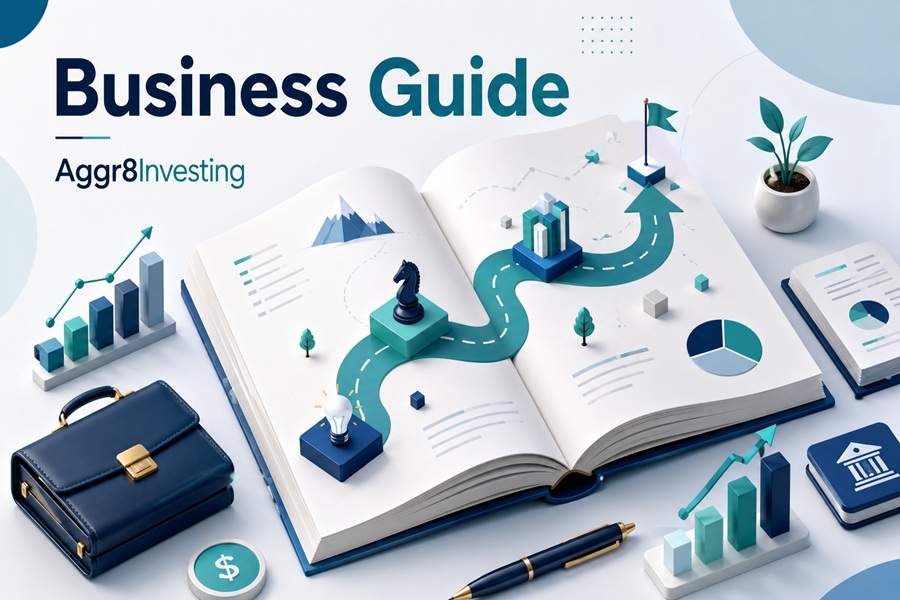
Quick answer: Business Guide Aggr8Investing is best understood as a practical framework that blends two skills most guides treat separately: building a business and investing intelligently. Instead of choosing between running a company and growing capital, the approach treats them as one system. You plan the business, fund it wisely, allocate capital with discipline, and reinvest returns to compound growth. This guide breaks the framework into clear pillars you can apply, whether you are a founder, a solopreneur, or an investor.
A note on the name: coverage of “Aggr8Investing” varies across the web, describing it as a platform, a strategy, and a framework. This guide takes the most useful and defensible reading: a framework for thinking about business and investment together.
This article is educational and not personalized financial, legal, or investment advice. Consult a qualified professional before making financial decisions.
What is the Aggr8Investing approach, really?
At its core, the idea is simple. Most business advice ignores investing. Most investing advice ignores running a business. The Aggr8Investing framework connects them.
The name hints at “aggregate.” You aggregate business strategy, capital allocation, and financial literacy into one decision-making system rather than juggling them in isolation.
Think of it as a mindset shift. A founder who understands investing makes smarter funding and reinvestment choices. An investor who understands operations picks better businesses. Combining both is the edge.
What are the pillars of the framework?
The approach rests on a few connected pillars. Each strengthens the others.
| Pillar | Focus | Why it matters |
|---|---|---|
| Business planning | Goals, model, market, execution | A clear plan lowers risk and guides every decision |
| Capital and funding | Budgeting, funding stages, cash flow | Money fuels growth and survival, so manage it deliberately |
| Investment literacy | Risk, diversification, returns | Reinvesting returns compounds growth over time |
| Digital growth | SEO, automation, branding, reach | Modern reach turns a good business into a visible one |
| Risk management | Analysis, liquidity, contingencies | Protecting the downside keeps you in the game |
Pillar 1: Start with a real business plan
Every business or investment journey starts with planning. Without a clear strategy, the risk of loss rises.
Define your goals before anything else. A short-term profit goal calls for a different strategy than long-term wealth creation. Then work through the essentials: your model, your market, your competition, and how you will reach customers.
The three planning habits that matter most:
- Set clear objectives. Know exactly what success looks like.
- Manage the budget. Track what comes in and what goes out.
- Research the market. Base decisions on data, not hope.
Pillar 2: Fund and allocate capital with discipline
Smart investing is not just for investors. It is a survival tool for businesses.
Understand your funding options as you grow, from early self-funding through later stages if you raise money. Watch the numbers that reveal health: customer acquisition cost, customer lifetime value, burn rate, and return on investment.
The discipline that separates winners: track your metrics rigorously so you can anticipate shocks and keep enough cash on hand. Liquidity buys you time, and time saves businesses.
Pillar 3: Build investment literacy
Investing literacy turns profit into lasting wealth. The core ideas are timeless.
- Define your time horizon. Short-term and long-term goals need different strategies.
- Diversify. Spreading capital across different assets or bets reduces the damage from any single failure.
- Understand risk before return. A higher potential return almost always carries higher risk. Know which you are accepting.
- Reinvest to compound. Returns put back to work grow faster than returns spent.
These principles apply whether you are investing surplus business profit or personal savings.
Pillar 4: Grow through a strong digital presence
Modern entrepreneurship demands visibility. A great business nobody can find still fails.
Build a digital ecosystem: search visibility through SEO, automation to save time, a customer relationship system to manage contacts, and consistent branding across channels. Content and SEO bring organic reach that compounds, much like an investment.
The point is not to chase every platform. It is to build durable, owned channels that keep working.
Pillar 5: Manage risk at every step
Technology and speed help you move fast, but moving too fast without knowledge causes avoidable mistakes.
Treat risk management as constant, not occasional. Analyze what could go wrong, keep reserves for shocks, and avoid betting everything on one outcome. The goal is not to eliminate risk, which is impossible, but to size it so a single loss never ends the journey.
How do you apply the framework in practice?
Put the pillars in sequence, then loop.
- Plan. Write down goals, model, and market. Define what success means.
- Budget and fund. Set a budget, understand your funding path, and protect cash flow.
- Execute and measure. Launch, then track the metrics that matter.
- Reinvest. Put returns back into the highest-return areas, whether growth or investment.
- Review and adjust. Read the data, manage risk, and refine. Then repeat.
The framework is a loop. Each cycle uses what you learned in the last one.
What are the common mistakes to avoid?
The same errors trip up founders and investors alike.
- Skipping the plan. Acting without clear goals invites loss.
- Ignoring cash flow. Profit on paper means nothing if you run out of cash.
- Concentrating risk. Betting everything on one idea or asset is fragile.
- Chasing hype over knowledge. Using tools or trends you do not understand is expensive.
- Never reinvesting. Spending every return stops the compounding that builds wealth.
What do entrepreneurs and investors say?
Practitioner communities reinforce the framework’s logic.
- On Reddit, founders repeatedly stress cash-flow discipline over vanity growth. The businesses that survive are the ones that watch the money, not just the revenue.
- On Quora, investors emphasize diversification and time horizon above stock picking. Boring discipline beats clever bets over the long run.
- On Medium, entrepreneurs who blend operating and investing describe reinvestment as their real engine. Profit that goes back to work, rather than getting spent, is what compounds a small business into a large one.
The shared theme: plan, protect cash, diversify, and reinvest. Discipline compounds.
Frequently asked questions
What is Business Guide Aggr8Investing?
It is best understood as a framework that combines business planning, capital allocation, investment literacy, digital growth, and risk management into one decision-making system for founders and investors.
Who is the framework for?
Startup founders, solopreneurs, and investors who want to run and fund a business intelligently rather than treating operations and investing as separate skills.
Is this financial advice?
No. It is an educational framework. For decisions about your own money, consult a qualified financial, legal, or tax professional.
How do I start applying it?
Begin with a clear plan and defined goals, set a budget, protect your cash flow, then measure results and reinvest returns in a disciplined loop.
What is the biggest risk to avoid?
Concentrating everything in one bet and ignoring cash flow. Diversify, keep reserves, and never let a single loss end the journey.