Category: Digital Marketing

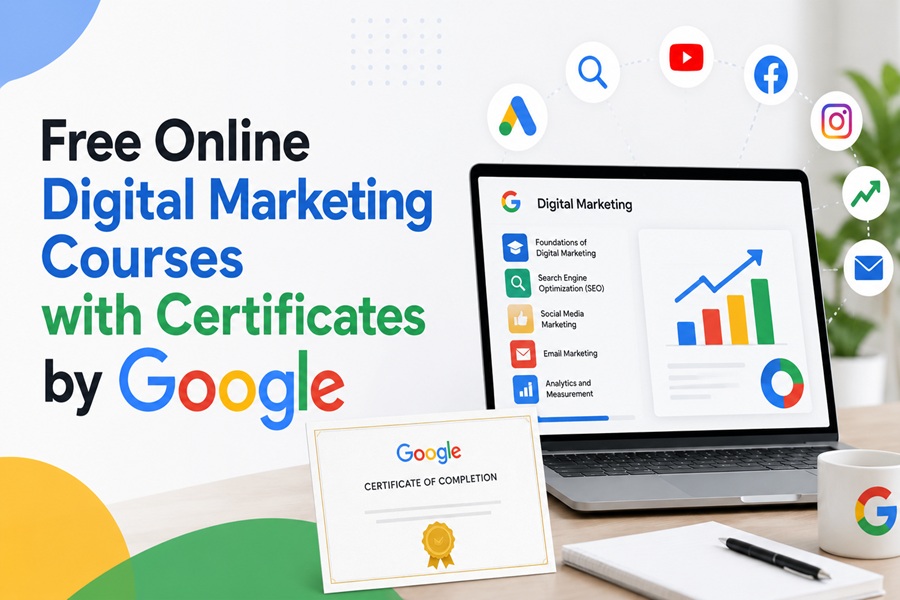
  • Free Online Digital Marketing Courses With Certificates by Google: What Changed and What Is Still Free

    Free Online Digital Marketing Courses With Certificates by Google: What Changed and What Is Still Free

    Quick answer: Google still offers free online digital marketing courses with certificates, but the home has changed. The old Google Digital Garage has moved into Google Skillshop. The flagship course, Fundamentals of Digital Marketing (around 40 hours, self-paced), is free and still awards a certificate after you pass the final assessment. Google Ads and Google Analytics certifications are also free on Skillshop. The one that is not truly free is the Google Digital Marketing and E-commerce Certificate on Coursera, which usually needs a paid subscription.

    If you searched for these courses and landed on a broken Digital Garage link, this guide explains what happened and where to go now.

    What happened to Google Digital Garage?

    Here is the update most course listicles still get wrong.

    Google Digital Garage has been folded into Google Skillshop. The standalone Digital Garage site is no longer the place to take these courses. Google has also discontinued the old certificate validation feature that used to live on the Digital Garage domain.

    What this means for you:

    • New learners: take Fundamentals of Digital Marketing on Skillshop instead of the old Digital Garage site.
    • Past learners: if your old certificate link no longer resolves, log in to Skillshop with the same Google account you originally used. Most certificates are tied to that account and can be re-verified there, not lost.

    This single change causes real confusion. Learners on Quora and the Google Ads community forums have posted about locked courses and certificates they could no longer access after the move. The fix is almost always the same account login, not a lost credential.

    Which free Google digital marketing courses give you a certificate?

    Google’s free, certificate-bearing training now sits across Skillshop and Google’s analytics learning. Here is the current picture.

    Course Platform Duration Certificate Cost
    Fundamentals of Digital Marketing Skillshop Around 40 hours, self-paced Yes, after final assessment Free
    Google Ads Search Certification Skillshop A few hours Yes Free
    Google Ads Display, Video, and other tracks Skillshop A few hours each Yes Free
    Google Analytics certification Google (Analytics learning) 4 to 6 hours Yes Free
    Google Digital Marketing and E-commerce Certificate Coursera Around 6 months at 10 hours a week Yes, professional certificate Paid subscription (financial aid may apply)

    The honest distinction:

    • Free and certificated by Google: Fundamentals of Digital Marketing, Google Ads certifications, and Google Analytics certification, all on Skillshop or Google’s own learning tools.
    • Not strictly free: the Coursera professional certificate. It is more in-depth and job-focused, but it usually requires a monthly fee. Financial aid exists, so it is not always out of reach, but it does not match the “free by Google” promise on its own.

    What do you learn in Fundamentals of Digital Marketing?

    This is the course most people mean when they search for free Google digital marketing courses. It is beginner-friendly and needs no prior experience.

    It runs through a structured path of modules covering:

    • Digital marketing strategy: building a plan across channels.
    • Search engine optimization (SEO): improving how your site ranks.
    • Search engine marketing (SEM) and Google Ads: paid search basics.
    • Social media marketing: using platforms to reach an audience.
    • Content marketing: creating material that attracts and engages.
    • Email marketing: nurturing leads and driving conversions.
    • Analytics and data: reading performance and making decisions from it.
    • Ecommerce and getting a business online: foundations for selling digitally.

    Newer versions also touch modern topics like using AI tools in content and campaigns, which keeps the material current with how marketing actually works today.

    How do you enroll and get the certificate?

    The process is straightforward and free.

    1. Go to Skillshop and sign in with a Google account. This is where Digital Garage content now lives.
    2. Find Fundamentals of Digital Marketing in the catalog and start the course.
    3. Work through the modules at your own pace. Each includes short lessons and quizzes.
    4. Pass the final assessment. You need to clear the minimum score to qualify.
    5. Download your certificate and add it to your LinkedIn profile or portfolio.

    There are no prerequisites, no fees, and no deadline. You can pause and return whenever you like.

    Are free Google digital marketing certificates worth it?

    Here is the balanced view, not the “it is amazing and free” version.

    Where they help:

    • They give beginners a genuine, structured foundation across every core discipline.
    • The name recognition is strong. Google’s Fundamentals course and HubSpot Academy’s digital marketing course are the two most commonly recommended starting points for beginners.
    • The certificate is real, free, and can go straight on LinkedIn.

    Where to set expectations:

    • A foundational certificate signals you understand the basics. It is not, on its own, proof of hands-on campaign experience.
    • Employers increasingly value practical, measurable skills, such as actually running an ad campaign or analyzing engagement data, more than a certificate alone.
    • For job-ready depth, the paid Coursera professional certificate or real practice on live campaigns carries more weight.

    The smart play: use the free Skillshop course to build your base, then prove the skills with a small real project or a deeper credential.

    How does Google compare to other free options?

    Google is not the only free source. A quick comparison helps you choose.

    Provider Strength Certificate
    Google (Skillshop) Broad fundamentals, strong brand recognition Free
    HubSpot Academy Inbound, content, and email marketing depth Free
    Coursera (audit mode) University-style courses across many topics Certificate usually paid
    Class Central listings Directory of hundreds of free marketing courses and badges Varies by course

    For most beginners, starting with Google’s Fundamentals of Digital Marketing and adding a HubSpot course covers the essentials without spending anything.

    What do learners say on the forums?

    Community feedback adds useful, real-world context that polished course pages leave out.

    • On Quora, the most common thread is not about course quality but about access after the Skillshop move. Several learners report old Digital Garage certificate links breaking, and the working answer is to log in with the original Google account.
    • On Reddit, learners generally rate the Fundamentals course as a solid, free starting point, while noting it is introductory and should be paired with practice.
    • On Medium, marketers who completed it often frame it as step one, valuable for the vocabulary and structure, then followed by hands-on work to make the knowledge stick.

    The consistent message: good foundation, real certificate, but treat it as a launch pad rather than a finish line.

    An insight the standard listicles miss

    Most “free Google course” articles still describe Digital Garage as a live standalone site with a working certificate-validation page. Both points are now out of date.

    • Digital Garage content lives inside Skillshop.
    • The old certificate-validation feature is discontinued.
    • Skillshop is also much larger than Digital Garage was, with over 150 courses across marketing, career development, and data and tech, not just the handful the old site offered.

    Knowing this saves you from chasing a dead link and shows you where the current, free, certificate-bearing courses actually are.

    Frequently asked questions

    Are Google’s digital marketing courses really free?

    Yes. Fundamentals of Digital Marketing, Google Ads certifications, and Google Analytics certification are free and award certificates. The Coursera professional certificate is the paid exception.

    Do I get a certificate from Google?

    Yes, after completing the modules and passing the final assessment. You can download it and add it to LinkedIn.

    Where do I take the course now that Digital Garage moved?

    On Google Skillshop. Sign in with a Google account and find Fundamentals of Digital Marketing in the catalog.

    I lost my old Digital Garage certificate. Can I get it back?

    Log in to Skillshop with the same Google account you used originally. Most certificates carry over and can be re-verified there.

    Is the certificate recognized by employers?

    It is recognized as a credible foundation, especially paired with hands-on practice. For job-ready depth, employers weight practical skills and deeper certificates more heavily.

    How long does the Fundamentals course take?

    Around 40 hours of self-paced learning, which you can spread over days or weeks.

  • Digital Marketing for Construction Companies: The Lead-Generation Playbook

    Digital Marketing for Construction Companies: The Lead-Generation Playbook

    Quick answer: Digital marketing for construction companies means using online channels (local SEO, Google Business Profile, Local Service Ads, paid search, content, and video) to win project leads instead of relying on referrals alone. Residential contractors win with local SEO, Local Service Ads, and reviews, often for under $500 a month. Commercial firms win with bid platforms, service-area pages, and direct outreach to general contractors, developers, and property managers. The rule that saves the most money: pick two channels and go deep.

    You compete inside a market of nearly 4 million active construction businesses. Most of them are poor at generating leads online. That gap is your opening.

    Why does digital marketing matter for construction companies now?

    Word of mouth still works, but it is no longer enough on its own. Buyers research before they call.

    • Around 59 percent of consumers use a search engine to research a purchase before committing.
    • Procurement teams and property managers routinely search your company name to vet you, even when the job came through a tender or referral.
    • AI search tools such as Google’s AI Overviews and chat assistants now surface “trusted answers.” If your site is not structured to be quoted, a competitor’s is.

    The takeaway is simple. Whether a lead is residential or commercial, your online presence is now part of how you get chosen.

    Which channels actually generate construction leads?

    Not every channel deserves your budget. The right mix depends on whether you serve homeowners or commercial buyers.

    Channel Residential fit Commercial fit What it does
    Google Business Profile + local SEO Essential Useful Puts you in the map pack for “near me” searches
    Google Local Service Ads Essential Limited Pay-per-lead ads with the Google Guaranteed badge
    Google Search Ads (PPC) Strong Strong Captures high-intent searches fast
    Bing / Microsoft Ads Underused Underused Similar conversions at lower cost per lead
    Meta (Facebook, Instagram) Ads Strong Weak Reaches homeowners with visual, targeted campaigns
    LinkedIn Ads Weak Strong Targets project managers, developers, and facilities leads
    Bid platforms (Dodge, ConstructConnect) Not relevant Essential Steady flow of commercial project opportunities
    Content, SEO pages, and video Strong Strong Builds trust and long-term organic visibility

    Two channel facts that surprise most contractors:

    • Reddit is not a paid-ad channel for local contractors. Skip it for lead generation. It suits different business models.
    • Bing quietly converts. In many contractor markets, especially those with older homeowner demographics, Microsoft Ads traffic converts at nearly the same rate as Google at a fraction of the cost. Almost nobody tests it. You can import a Google campaign in about twenty minutes and run it for sixty days to compare.

    What do construction leads cost?

    Knowing your numbers is how you tell a working channel from one that is bleeding you dry. Cost per lead varies by trade, region, and channel, but the patterns are consistent.

    • Residential local channels (Google Business Profile, Local Service Ads, reviews) can be run for under $500 a month combined and usually beat paid lead marketplaces on cost and quality.
    • Paid search delivers quick, high-intent leads but costs more per click in competitive trades like roofing and remodeling.
    • Marketplace leads (shared lead sellers) are often the most expensive per booked job because the lead is sold to several contractors at once.

    A healthy benchmark: allocate 5 to 10 percent of annual revenue to marketing, with 60 to 70 percent of that going to digital channels.

    The residential contractor playbook

    If your customers are homeowners, follow this order.

    1. Fix your Google Business Profile first. Complete every field, add real project photos, and keep hours accurate. This is your highest-return asset and it is free.
    2. Build service-area and service-specific pages. One page per core service and per town you serve. A page for “kitchen remodel” beats a generic homepage every time.
    3. Turn on Google Local Service Ads. Pay per lead, earn the Google Guaranteed badge, and appear above regular search results.
    4. Build a review engine. Ask every happy customer, respond to every review, and make it routine. Reviews drive both trust and local ranking.
    5. Add Meta Ads for demand. Use real project photos and target by location and homeowner intent. Send every ad to a dedicated landing page, never the homepage.
    6. Speed up your site. A slow or confusing page means you paid for a click that will not convert.

    The commercial contractor playbook

    If you chase tenders, build-outs, and developer work, the moves are different.

    1. Get on bid platforms. Dodge and ConstructConnect give you a steady flow of project opportunities.
    2. Run direct outreach. Find general contractor, developer, and property manager contacts and reach them before bids even drop.
    3. Build authority pages. Pages like “commercial fit-outs” or “infrastructure projects” help you show up and make a strong impression when procurement teams Google you.
    4. Use LinkedIn, not Meta. Target decision-makers by job title, company size, and industry through sponsored content or direct messages.
    5. Run a small branded search campaign. Even if most work comes from RFPs, protect your name in search so vetting buyers find a clean, credible result.

    How do you make a construction site rank in search?

    Search visibility rests on a few fundamentals done consistently.

    • Keyword-matched pages: target the exact phrases buyers use, such as “commercial concrete company [city]” or “home addition contractor [city].”
    • Local signals: a complete Google Business Profile, consistent name, address, and phone details, and genuine reviews.
    • Fast, mobile-first site: most searches happen on phones, and speed affects both ranking and conversions.
    • Schema markup: structured data helps search engines and AI tools read your services and quote you in answers.
    • Real content: project write-ups, guides, and photos that prove expertise and depth.

    Common mistakes that quietly hurt rankings: a weak Google Business Profile, no service-area pages, ignoring reviews, slow site speed, wrong keyword targeting, missing schema, and no conversion tracking.

    Which numbers should you track?

    Marketing without measurement is guesswork. Tie every channel to leads and revenue.

    Metric What it tells you
    Cost per lead (CPL) Whether a channel is affordable
    Cost per acquisition (CAC) What a booked job actually costs to win
    Lead-to-job conversion rate How well leads turn into contracts
    Call and form tracking Which channels drive real inquiries
    Return on ad spend (ROAS) Revenue earned per dollar of ad spend
    Google Business Profile actions Calls, direction requests, and clicks from local search

    Review these monthly. If a channel cannot show its numbers, it cannot earn more budget.

    What do contractors say works on the forums?

    Practitioner communities cut through agency sales talk, and their patterns line up with the data.

    • On Reddit, contractors repeatedly say the fastest way to burn cash is spreading budget across five platforms. The advice that comes up again and again is to master one or two channels first, usually Google Business Profile and Local Service Ads for residential.
    • On Quora, tradespeople note that leads from Google search tend to convert better than shared marketplace leads, because a marketplace sells the same lead to several competitors at once.
    • On Medium, construction marketers stress that procurement teams vet you online even for referral work, so a clean, credible site matters as much for commercial firms as for residential ones.

    The shared lesson: depth beats spread, owned channels beat rented ones, and your website earns trust long before a call comes in.

    An edge most construction marketing guides miss

    Three points give you an advantage your competitors are ignoring.

    AI search visibility is now a channel. As AI Overviews and chat assistants answer buyer questions directly, sites with clear structure and schema get quoted while others disappear. Structuring your service pages as clear answers is no longer optional.

    Microsoft Ads is the cheapest test you are not running. Importing an existing Google campaign takes minutes, and in older-demographic markets the cost per lead can be markedly lower for similar conversion quality.

    Channel choice is trade-specific. Residential lives on Meta and local search. Commercial lives on LinkedIn, bid platforms, and outreach. Running the wrong channel for your model is the most common and most expensive mistake in construction marketing.

    Frequently asked questions

    Do people really hire construction companies from Google?

    Yes. High-intent local searches drive calls and booked projects worth thousands, and even RFP-driven buyers Google you during vetting.

    Should a construction company do SEO or Google Ads?

    Both, in sequence. Paid ads drive leads immediately while SEO builds durable, lower-cost visibility. Avoid paying for branded clicks you would earn organically.

    How much should a construction company spend on marketing?

    Aim for 5 to 10 percent of annual revenue, with most of it directed to digital channels.

    What is the fastest way to get more construction leads?

    For residential, optimize your Google Business Profile, switch on Local Service Ads, and build a review habit. For commercial, get on a bid platform and start direct outreach.

    Is social media worth it for contractors?

    For residential, yes, especially Meta with real project photos. For commercial, LinkedIn is the better fit and general social plays only a supporting role.

  • Digital Marketing Agency for Small Businesses: Costs, Trade-offs, and How to Choose Right

    Digital Marketing Agency for Small Businesses: Costs, Trade-offs, and How to Choose Right

    Quick answer: A digital marketing agency for small businesses handles the online channels that bring you customers, mainly SEO, paid ads, social media, email, and web work. Most small firms pay between $1,000 and $5,000 per month on a retainer, with $3,000 to $5,000 the most common range once a business is established. The agencies worth hiring prove results in one core channel, name real reference clients, and report on leads and revenue, not vanity metrics.

    That is the short version. The rest of this guide gives you the numbers, the red flags, and a way to choose that most listicles skip.

    What does a digital marketing agency for small businesses actually do?

    An agency is a rented marketing team. Instead of hiring an SEO, a paid-ads specialist, a designer, and a copywriter in-house, you buy their combined hours for a fixed monthly fee.

    Typical services include:

    • Search engine optimization (SEO): ranking your site and Google Business Profile so buyers find you organically.
    • Pay-per-click (PPC) advertising: Google Ads and Bing Ads that put you at the top of results for high-intent searches.
    • Social media management: organic posting plus paid campaigns on Meta, Instagram, LinkedIn, and TikTok.
    • Content marketing: blog posts, landing pages, and lead magnets that pull in traffic and build trust.
    • Email marketing and automation: nurture sequences that turn leads into repeat customers.
    • Web design and conversion work: fast, mobile-friendly sites that turn clicks into calls and bookings.
    • Analytics and reporting: tracking what each channel returns so budget flows to what works.

    The value is not the list. It is having specialists in each area for the price of far less than one senior hire.

    How much does a small business digital marketing agency cost?

    Pricing depends on scope, the number of channels, and how competitive your market is. Here is what real quotes look like across the market.

    Monthly budget What it realistically buys Best for
    Under $1,000 One focused task or a freelancer. Not a full agency. Put most of it into ad spend or one channel. Brand-new businesses, very local services
    $1,000 to $2,500 A single high-return channel done well, such as local SEO or a tight Google Ads campaign Solo owners and early-stage firms
    $2,500 to $5,000 A dedicated retainer for one or two channels, plus media budget Established small businesses ready to scale
    $5,000 to $10,000+ Multi-channel management with strategy, content, and reporting Growing firms with proven demand

    A few pricing facts worth knowing:

    • Project fees run wide. One-off work like a new site, a technical audit, or a brand refresh usually lands between $1,000 and $30,000 depending on complexity.
    • Retainers dominate. Roughly four in five agencies use monthly retainers as their main billing model, because SEO and paid ads need daily attention.
    • Service prices vary by discipline. SEO commonly runs $500 to $5,000 a month. PPC management often sits between $1,000 and $10,000, separate from the ad spend itself.

    What is a healthy marketing budget for a small business?

    A common benchmark from the Small Business Administration and agency practice is 7 to 12 percent of annual revenue. Spend toward the higher end (10 to 12 percent) when you are pushing for growth, and toward the lower end (5 to 7 percent) once you have a steady customer base.

    A useful framework for splitting that budget is the 70-20-10 rule:

    • 70 percent into proven, low-risk channels that already work for you.
    • 20 percent into growth channels you are scaling up.
    • 10 percent into experiments and new ideas.

    This keeps most of your money on safe returns while still testing what could become your next big channel.

    Agency, freelancer, or in-house team: which is right?

    This is the decision most owners get stuck on. Each option trades cost against control and range of skills.

    Option Typical monthly cost Strengths Watch-outs
    Freelancer Lowest, highly variable Cheap, flexible, direct contact One skill set, limited capacity, single point of failure
    Agency $1,000 to $10,000+ Full range of specialists, tools, and processes Higher cost, you may be a small account
    In-house hire Salary plus benefits and overhead Full focus on your brand, always available Expensive, hard to cover every channel with one person

    The honest takeaway from people who have tried all three: freelancers suit very small budgets and single tasks. Agencies make sense when you need several channels handled at once. In-house works when marketing is central enough to justify a full salary.

    How do you choose a digital marketing agency that actually delivers?

    Most agencies pitch full-funnel mastery. In practice, they are strong in one or two channels and run a template on the rest. An SEO-led shop often produces weak paid social. A performance-ad shop often writes generic blog content.

    So judge each agency on the one channel that drives your revenue. Work through this order:

    1. Identify your single biggest growth lever. Organic search, paid acquisition, email and retention, organic social, or local SEO. Pick one.
    2. Check specialization in that lever. Ask them to prove depth in the channel you named, not their all-round pitch.
    3. Demand relevant case studies. A B2B SaaS win tells you almost nothing about marketing a local service business. Ask for results in your model and market.
    4. Read third-party reviews. Look beyond testimonials on their own site.
    5. Review their discovery and reporting process. Good agencies ask sharp questions before quoting and show you exactly how they report.
    6. Match team size to your retainer. A mid-tier boutique that treats your budget as real will usually beat a large agency where your retainer is a rounding error and your account lands with the most junior staff.
    7. Confirm communication. Know who you talk to, how often, and how fast they respond.
    8. Weigh pricing last. The cheapest quote that ignores your revenue driver is the most expensive mistake.

    What are the red flags to avoid?

    Walk away from any agency that does the following:

    • Guarantees rankings or specific results. No honest partner can promise a number one spot.
    • Refuses to name reference clients. Transparency is the baseline, not a favor.
    • Asks for admin access under their own login. Your accounts, ad platforms, and analytics should stay in your ownership.
    • Reports only vanity metrics. Likes and impressions are not leads or revenue.
    • Locks you into long contracts with no clear exit. Confidence shows up as flexible terms.

    What do small business owners say about hiring an agency?

    Practitioner communities are blunt about this, and their patterns are worth reading before you sign.

    • On Reddit and small-business forums, owners repeatedly warn against spreading a small budget across five platforms at once. The consensus is to pick one or two channels and go deep, because a thin budget scattered everywhere returns close to nothing.
    • On Quora, a recurring theme is that agencies deliver best when the owner sets a clear, single goal (more leads, more ecommerce sales, or local visibility) rather than asking for everything at once.
    • On Medium, marketers who have worked agency-side often admit the same thing this guide states: most teams are genuinely strong in one or two channels and average on the rest, so hiring for your revenue driver matters more than the size of the service menu.

    The signal across all three is consistent. Focus beats breadth, and clear goals beat big promises.

    An insight most agency articles leave out

    Two points rarely make it into the standard listicles, and both save money.

    First, the “rounding error” problem. When your retainer is trivial to a large agency, your account gets handed to junior staff and a template. A smaller boutique with real small-business case studies will often outperform a bigger name at the same price, simply because your success matters to them.

    Second, channel fit beats channel count. The number of services an agency offers tells you nothing about whether they can move your specific numbers. A florist, a plumber, and a SaaS startup need completely different playbooks. Ask for proof in your exact model before anything else.

    Frequently asked questions

    Is it worth hiring a digital marketing agency for a small business?

    Usually yes, if the agency is genuinely skilled and you have a clear goal. You gain specialist skills, current tools, and strategy that would cost far more to build in-house. The risk comes from picking the wrong partner, not from the model itself.

    How much should a small business spend on digital marketing?

    Plan for 7 to 12 percent of annual revenue. Push higher when chasing growth and lower once you have steady customers.

    What is the cheapest way to start?

    Put a small budget into one high-return area, such as claiming and optimizing your local search profiles or running a focused search campaign. Avoid splitting a tiny budget across many platforms.

    How long before an agency shows results?

    Paid ads can drive leads within weeks. SEO and content usually take three to six months to build momentum, then compound over time.

    Should I choose a specialist or a full-service agency?

    Choose the team that best serves your single biggest growth channel. A specialist in that channel almost always beats a generalist spread thin.