Category: Social Media Marketing

  • What Are Social Media Marketing Tools? Categories, Examples, and How to Choose

    What Are Social Media Marketing Tools? Categories, Examples, and How to Choose

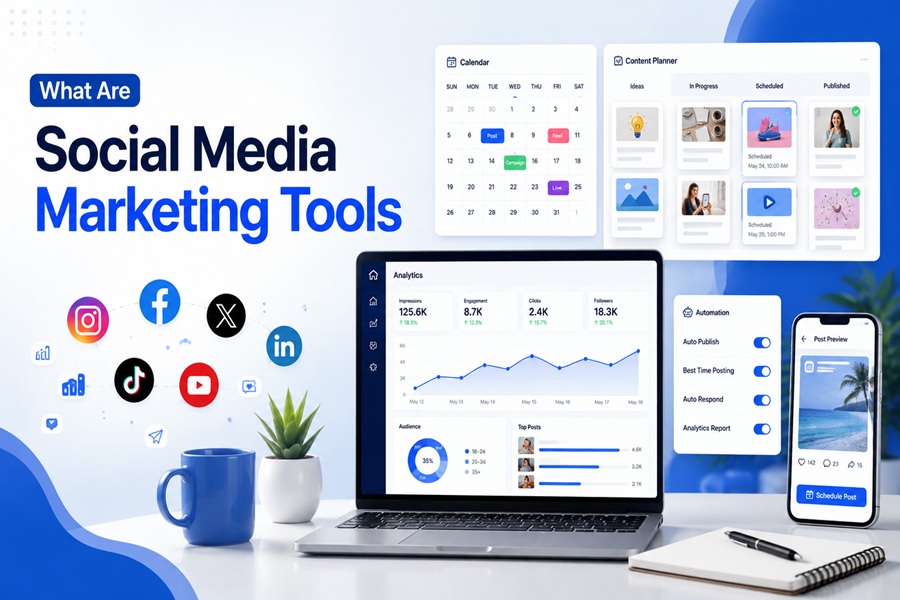
    Social media marketing tools are apps that help you plan, create, publish, manage, and measure social media content in one place. They fall into a few core categories: scheduling and publishing, analytics and reporting, social listening, content creation and design, and AI-powered automation. Popular examples include Buffer, Hootsuite, Sprout Social, Later, Metricool, Canva, and Brandwatch. The right tool depends on your team size, budget, and which of those jobs you most need to solve.

    Native platform apps do not do enough on their own. Many, like Reddit, lack built-in scheduling and analytics entirely, which is exactly why these tools exist.

    Here is what each category does, who it suits, and how to build a stack without overpaying.

    What do social media marketing tools actually do?

    At their core, these tools remove manual, repetitive work and centralize your social operation.

    They started as simple calendar-based schedulers. They have grown into full workflow systems that handle content planning, approval, publishing, engagement, and performance tracking together.

    The main jobs they solve:

    • Save time by scheduling posts in advance across many platforms.
    • Keep content consistent with a shared calendar and approval steps.
    • Centralize engagement so replies and mentions live in one inbox.
    • Prove results with analytics that native apps rarely match.
    • Speed up creation with design and AI assistance.

    This makes them essential for both solo owners and large teams.

    What are the main categories of social media tools?

    Most tools fit into one of these buckets. Some do several jobs, but each usually leads with one strength.

    Category What it does Representative tools
    Scheduling and publishing Plan and auto-post across platforms Buffer, Hootsuite, Later, SocialPilot, Publer
    All-in-one management Scheduling plus engagement and reporting Sprout Social, Sendible, Metricool
    Analytics and reporting Measure reach, engagement, and ROI Sprout Social, Social Status, Metricool
    Social listening Track mentions, sentiment, and trends Brandwatch, Brand24
    Content creation and design Make graphics and video fast Canva, CapCut
    AI content and automation Generate captions, ideas, and posts StoryChief, Predis.ai, SocialBee

    Pick the category that matches your biggest pain point first, then expand.

    Scheduling and publishing tools

    This is the category most people mean when they say “social media tool.”

    These tools let you plan a week or a month of posts, then publish automatically across Instagram, Facebook, LinkedIn, X, and more from one dashboard.

    Common features:

    • Bulk scheduling and a visual drag-and-drop calendar.
    • Post previews per network to catch formatting issues before they go live.
    • Basic analytics and, increasingly, AI caption help.

    Buffer suits creators and small teams that want simplicity. Hootsuite suits mid-sized businesses and agencies managing many accounts. Later leans visual-first, strong for Instagram and TikTok.

    Analytics and reporting tools

    You cannot improve what you do not measure. These tools turn raw activity into decisions.

    They report reach, engagement rate, follower growth, clicks, and campaign performance, often with customizable dashboards and automated reports.

    Sprout Social pairs deep analytics with scheduling and listening. Metricool is popular for managing and reporting across many accounts affordably. Social Status leans into paid campaign and influencer analytics.

    A smart move: calculate ROI per channel separately. Combined numbers hide which platform actually earns its keep.

    Social listening tools

    Listening tools tell you what people say about your brand and industry when you are not in the room.

    They track mentions, hashtags, sentiment, and emerging trends in real time. That helps with reputation management, crisis alerts, and spotting content opportunities.

    Brandwatch suits in-depth analysis and sentiment tracking. Brand24 is a favorite for real-time monitoring at a lower price point.

    Content creation and AI tools

    These speed up the most time-consuming part of social: making the content.

    Design tools like Canva let non-designers produce polished graphics and short video quickly. AI tools generate captions, post ideas, and content calendars, and some produce images or video.

    But here is where honesty matters, and where most listicles mislead you.

    An honest look at “AI” social media tools

    The AI label is oversold. Before you pay, know what you are actually buying.

    • Many “AI tools” are just schedulers with a caption writer. They market themselves as AI-first, but the core product is scheduling plus a writing assistant. That is fine, as long as you know it.
    • “AI video” is usually a slideshow. Most AI-generated social video is kinetic style: text and images with motion, transitions, and music. Fully rendered, synthetic-scene video is far rarer than the marketing suggests.
    • No legitimate tool sells you followers. Bought followers do not engage, do not buy, and can get your account penalized. Any tool promising followers is a trap.

    Used well, AI genuinely helps: generating drafts, suggesting post times, and mapping performance. Just buy it for what it does, not for the buzzword.

    Do you still need tools if platforms have native apps?

    Yes, and here is the clearest proof.

    Some platforms give you almost nothing to work with. Reddit, for example, has strong community reach but no native post scheduling and no built-in analytics, a complaint creators raise constantly. Even where native tools exist, they rarely match a dedicated platform for cross-network scheduling and reporting.

    Third-party tools fill that gap, letting you manage every network in one place instead of juggling separate apps.

    How do you choose the right tools?

    Do not buy a big suite before you need it. Follow this order.

    1. Name your biggest pain point. Inconsistent posting, weak reporting, or slow content creation.
    2. Pick one tool that solves it well. A focused tool beats a bloated suite you half-use.
    3. Check platform coverage. Confirm it supports the networks you actually use.
    4. Match it to team size. Solo creators need simplicity. Agencies need approval workflows and client reporting.
    5. Watch for tool sprawl. Many teams pay for overlapping tools. Consolidate where one platform covers several jobs.
    6. Try free tiers first. Several strong tools offer free plans, enough to start without spending.

    What do practitioners say about social media tools?

    Community reviews cut through the marketing, and the patterns are consistent.

    • On Reddit, social media managers praise all-in-one schedulers for saving hours across multiple accounts, while warning against paying for features they never touch. The recurring advice: start lean.
    • On Quora, marketers stress that a tool is only as good as the strategy behind it. Automation amplifies a good plan and exposes a bad one.
    • On G2 and Medium, reviewers repeatedly flag the gap in native platform tools, especially the lack of scheduling and analytics on some networks, as the main reason they adopt third-party software.

    The shared lesson: tools multiply the effort you put in. They do not replace a strategy, and buying more than you need wastes money.

    Two points rarely make the standard roundups, and both save real money.

    The AI label is doing heavy lifting. A large share of tools marketed as AI are schedulers with a writing assistant, and most “AI video” is a motion slideshow. Judge tools by their actual output, not their branding, and you will stop overpaying for hype.

    Consolidation beats collection. The most common tool mistake is sprawl: paying for five overlapping apps. One capable all-in-one platform often replaces three or four single-purpose tools at lower total cost. Audit your stack and cut the overlap.

    Frequently asked questions

    What are social media marketing tools used for?

    Planning, creating, scheduling, managing, and measuring social content across platforms, all from one place, to save time and prove results.

    Are there free social media marketing tools?

    Yes. Several strong schedulers and design tools offer free plans, enough for a solo owner or small business to start without cost.

    What is the best tool for a small business?

    It depends on your pain point. Buffer or Metricool suit simple scheduling and reporting. Canva covers design. Start with one that solves your biggest problem.

    Do AI social media tools actually work?

    Yes, for drafting captions, suggesting post times, and analyzing performance. Just know that many “AI” tools are schedulers with a writing assistant, and “AI video” is usually a slideshow.

    How many tools do I need?

    As few as possible. One capable all-in-one platform often replaces several single-purpose tools. Avoid paying for overlapping features.

  • Social Media Marketing Services for Small Businesses: What You Get and What It Costs

    Social Media Marketing Services for Small Businesses: What You Get and What It Costs

    Quick answer: Social media marketing services for small businesses bundle content creation, scheduling, community management, analytics, and strategy into a monthly package. Typical pricing runs from about $300 to $3,000 a month, with $750 to $2,000 the common range for a real managed service. The catch most owners miss: two packages at the same price can deliver completely different levels of work. What matters is not the price tag but what is actually included, and what is quietly left out.

    Here is a plain breakdown of the services, the tiers, the hidden exclusions, and how to choose a package worth paying for.

    What services are actually included?

    A social media package is a bundle. Instead of billing hourly for every post and call, agencies group services into a monthly retainer with a defined scope.

    Most packages combine some mix of these:

    • Content creation: the graphics, captions, and video that fill your feed. This is the most time-intensive part and the biggest driver of price.
    • Scheduling and publishing: planning and posting on a consistent calendar across your platforms.
    • Community management: replying to comments and messages, and engaging with your audience.
    • Analytics and reporting: tracking performance and showing what the work returned.
    • Strategy: setting goals, choosing platforms, and building a content plan tied to your business.

    Higher tiers add professional photography, long-form video, paid ad management, and a dedicated account manager.

    How much do social media marketing services cost?

    Pricing depends on the number of platforms, how many posts you get, the quality of video, and how much strategy is involved. Here is the real-world picture.

    Tier Typical monthly cost What you get Best for
    Starter $300 to $750 Basic posting on 1 to 2 platforms, light engagement, simple reporting New businesses testing social
    Growth $750 to $2,000 Original content, consistent posting, community management, real strategy Small businesses serious about social
    Full-service $2,000 to $5,000 Multi-platform, video, dedicated management, deeper reporting Established firms scaling up

    A few pricing facts worth knowing:

    • Entry packages start low. Some services begin around $250 to $500 a month, but expect basic posting rather than strategy or custom content.
    • A complete package sits near $3,000. Content, ads, and management tools bundled together commonly land around that figure.
    • Budget guidance: many owners allocate 5 to 10 percent of revenue to marketing, and 15 to 25 percent of the marketing budget to social specifically.

    What do platform add-ons cost?

    Pricing often scales by platform, because each one needs different content and effort.

    Platform Typical add-on range Why
    Facebook + Instagram $750 to $2,000 The most common base bundle
    LinkedIn $1,000 to $2,500 Content-heavy B2B strategy costs more
    TikTok / short video Higher Video production is labor-intensive

    The pattern is simple. The more video and the more B2B nuance a platform needs, the more it costs to do well.

    What is usually excluded but assumed?

    This is where owners overpay or feel let down. Many services quietly leave out things buyers assume are included.

    Commonly excluded from mid-tier packages:

    • Professional photography and on-site shoots.
    • Long-form or high-production video.
    • Paid ad management. Organic and paid are usually priced separately, and ad spend is always extra.
    • Influencer coordination.

    Two packages at $1,500 a month can look identical on paper and deliver wildly different work. The difference hides in the fine print, so read the scope, not just the headline price.

    Should you hire an agency, a freelancer, or do it yourself?

    Each route trades cost against range and reliability.

    Option Cost Strengths Watch-outs
    DIY Time only Full control, cheapest in cash Steep learning curve, easy to burn hours
    Freelancer Lower, variable Flexible, direct contact, affordable One skill set, limited capacity
    Agency Higher Full team, tools, processes Costs more, you may be a small account

    For most local and small businesses, a foundational organic package focused on community trust is the right starting point. Add paid advertising as a separate service once organic is working.

    How do you choose a package worth paying for?

    Ask questions that reveal the real work behind the proposal.

    1. What exactly is included each month? Get post counts, platforms, and content types in writing.
    2. Is the content original or templated? Original content costs more and performs better.
    3. Is video included, and at what quality? This is often the biggest hidden variable.
    4. Is paid advertising separate? Usually yes. Confirm it.
    5. How is performance reported? This is the key question below.
    6. How are scope changes handled? Know how extra requests are billed.

    If a provider pushes back on price, a good one adjusts the scope rather than slashing quality. That protects both sides.

    What should reporting actually show?

    Reporting is where value becomes visible, and where weak services hide.

    Ask what metrics are reported, how often, and whether they connect to business outcomes or just platform vanity numbers. Likes and impressions are not leads or sales.

    A strong report ties activity to results: reach, engagement, clicks, leads, and where possible revenue. If a provider only shows follower growth, that is a red flag.

    What do small business owners say on the forums?

    Community experience adds context the polished sales pages leave out.

    • On Reddit, small business owners repeatedly warn against the cheapest packages. The common story is paying a low monthly fee for generic, templated posts that move nothing. The advice is to pay a bit more for original content or do it yourself well.
    • On Quora, owners stress matching the package to one clear goal. Buying “everything” without a target wastes money. Buying focused help toward leads or local visibility pays off.
    • On Medium, marketers who have run these services echo the biggest trap: starting with a budget and working backward. Start with the outcome you want, then find the package that delivers it.

    The shared lesson: cheap templated posting rarely returns anything, and clarity of goal beats breadth of service.

    Frequently asked questions

    How much should a small business spend on social media marketing?

    Commonly $300 to $2,000 a month depending on goals, with 15 to 25 percent of the marketing budget a useful rule. Start small and scale as results show.

    What is included in a typical package?

    Content creation, scheduling, community management, basic analytics, and strategy. Higher tiers add photography, video, paid ads, and dedicated management.

    Is a freelancer or agency better for a small business?

    A freelancer suits a tight budget and a single focus. An agency suits multiple platforms and steadier delivery. Match the choice to your goal and capacity.

    Does a social media package include paid ads?

    Usually not. Organic management and paid advertising are typically priced separately, and ad spend is always extra.

    How do I know if a package is worth it?

    Judge the scope and the reporting, not the price. Original content plus reports tied to business outcomes signal real value.

  • How to Build a Social Media Marketing Team: Roles, Structure, and When to Hire

    How to Build a Social Media Marketing Team: Roles, Structure, and When to Hire

    Quick answer: To build a social media marketing team, start with one Social Media Manager who owns strategy and posting, then add roles as your needs grow: a Content Creator, a Community Manager, an Analyst or Strategist, and a Paid Social Specialist. Structure the team around your company size and goals, and use a hybrid model (in-house core plus freelancers or an agency) to fill gaps without overstretching. Social media is not one job, so one person rarely covers it all well.

    Here is how to decide which roles you need, in what order, and how to structure them as you scale.

    Why is one person rarely enough?

    The most common setup, even at large brands, is the “one-man show.” A single Social Media Manager owns everything.

    That person wears every hat: strategy, posting, design, community replies, and reporting. They lean on an already stretched marketing team for support that rarely comes. The design team has no time for social content. The manager wants more video but has to reuse old assets.

    It works until it does not. As social becomes a real growth channel, one person becomes the bottleneck. That is the signal to build a proper team.

    What are the core roles on a social media team?

    A high-performing team blends strategy, content, and analytics. These are the roles most teams add, and what each one owns.

    Role What they own When to add
    Social Media Manager Strategy, calendar, posting, brand voice First hire, always
    Content Creator Graphics, short video, captions, assets When content volume outgrows one person
    Community Manager Comments, DMs, engagement, customer care When engagement and response time slip
    Social Media Analyst / Strategist Reporting, insights, testing, optimization When you need proof and better decisions
    Paid Social Specialist Ad campaigns, targeting, budget, ROAS When you start spending on ads seriously

    Add roles in that rough order. Each one removes a bottleneck the previous setup created.

    How should the team be structured by company size?

    Your growth stage shapes the structure. Match the model to where you are.

    Startup or small business (lean and flexible): One Social Media Manager handles strategy, posting, and engagement. Freelancers or an agency come in for high-impact moments like a product launch. Other marketing staff pitch in on design or writing.

    Mid-sized company (one person per role): A Social Media Manager at the center, supported by a Content Creator and a Community Manager, with an Analyst as volume grows. This often replicates a small agency team inside the business.

    Enterprise (multiple specialized teams): A central strategy team sets direction, with regional or local teams handling execution. Roles split further into brand awareness, community, paid, and customer care, each with its own workflows and reporting.

    Agency (built for scale): Robust teams plus systems and processes to manage many clients at once. The margin for error is thin. Miss one client’s post and you damage trust.

    Should you build in-house, use an agency, or both?

    Most mature teams land on a hybrid model, and for good reason.

    In-house strengths: deep brand knowledge, faster iteration, tight integration with your data and voice, and full control.

    Agency or freelancer strengths: instant expertise, access to premium tools, and cross-platform experience without the overhead. Useful when testing multiple networks or running a big campaign.

    The hybrid answer: in-house strategists drive brand and voice, while agencies or freelancers fill execution gaps and channel-specific skills. A single manager can run day-to-day, bringing in a freelance video editor or a paid-social specialist only when needed.

    One proven tactic: hire a specialist freelancer for one high-impact gap rather than stretching your generalist. Targeted expertise often drives measurable growth without a full-time hire.

    How do you find the gaps in your team?

    Use a skills matrix. It is simple and it works.

    1. List the skills your goals require, such as strategy, video, copy, paid ads, analytics, and community management.
    2. Score your current team against each one.
    3. The low scores are your gaps.

    Fill each gap with the cheapest effective option: a freelancer, an agency, a tool, or a new hire, in that order of commitment. This keeps you from over-hiring before you need to.

    What skills should you hire for?

    Look past job titles to the underlying abilities.

    • Strategic thinking: the ability to tie social activity to business goals, not just fill a calendar.
    • Content and storytelling: turning ideas into scroll-stopping posts and video.
    • Data literacy: reading metrics and adjusting, not guessing.
    • Community and communication: responding fast, on-brand, and with judgment.
    • Adaptability: platforms and algorithms shift constantly, so learning speed matters.

    A generalist with strategic thinking and adaptability is often a better first hire than a narrow specialist.

    What new roles are emerging?

    The shape of social teams is changing, and hiring is rising. A large share of marketing leaders plan to grow social headcount, and many want specialized roles rather than generalists.

    Roles worth knowing as you plan for growth:

    • Social search optimization (SOSEO) strategist: optimizes content to be found through in-app and AI-driven search, as discovery shifts away from traditional search.
    • AI workflow specialist: builds AI into content creation, scheduling, and reporting to move faster.
    • Social customer care lead: owns support and service happening in comments and DMs.
    • Influencer marketing manager: runs partnerships, briefs, contracts, compliance, and ROI tracking. This role usually needs a few years of experience.

    Adding even one of these can shift a brand’s trajectory as consumer behavior and AI reshape how people discover products.

    What does a social media team cost?

    Costs depend on whether you hire, contract, or blend.

    • Full-time hires carry salary plus benefits and overhead, so each role is a real commitment.
    • Freelancers offer flexibility and lower ongoing cost, ideal for filling one gap.
    • Agencies bundle a whole team and tools into a monthly fee, useful before you can justify in-house salaries.

    Build the team your budget, goals, and skill gaps actually require. Do not hire a full roster before the workload demands it.

    What do practitioners say about building a team?

    Community advice cuts through the theory, and the patterns are consistent.

    • On Reddit, social media managers repeatedly describe burnout in the one-person model. The recurring advice is to add a Community Manager or Content Creator before the manager breaks, not after.
    • On Quora, hiring managers stress that strategic thinking is the hardest skill to find and the most valuable. Execution can be taught or outsourced. Judgment cannot.
    • On Medium, team leads favor the hybrid model, keeping brand and strategy in-house while renting specialized skills like video or paid ads as needed.

    The shared theme: hire for the bottleneck, keep strategy internal, and rent specialized skills rather than over-building.

    An insight most team-building guides miss

    Two points rarely make the standard advice, and both save money and pain.

    Sequence beats size. The question is not “how big should my team be,” but “what is my current bottleneck.” Solve one bottleneck per hire, in order, and you never carry a role you do not need yet.

    Discovery is moving, so plan for it. As AI and in-app search change how people find brands, the SOSEO strategist and AI workflow specialist are shifting from nice-to-have to core. Building a team for how discovery worked yesterday leaves you behind. Build for where attention is going.

    Frequently asked questions

    What is the first role to hire for social media?

    A Social Media Manager who can own strategy, posting, and brand voice. Everything else supports that role.

    How many people do you need on a social media team?

    It depends on scale. A small business can run on one manager plus freelancers. Mid-sized teams often run three to five. Enterprises run multiple specialized teams.

    Should a small business hire in-house or use an agency?

    Often an agency or freelancer first, for instant expertise and tools without overhead. Bring roles in-house once social justifies full salaries.

    What is a hybrid social media team?

    An in-house core that owns strategy and voice, supported by freelancers or an agency for execution and specialized skills.

    When should I add a paid social specialist?

    Once you commit real budget to ads. Paid social rewards specialized targeting and optimization that a generalist rarely has time to master.

  • What Are the 5 Steps in Social Media Marketing? The Framework That Turns Posts Into Customers

    What Are the 5 Steps in Social Media Marketing? The Framework That Turns Posts Into Customers

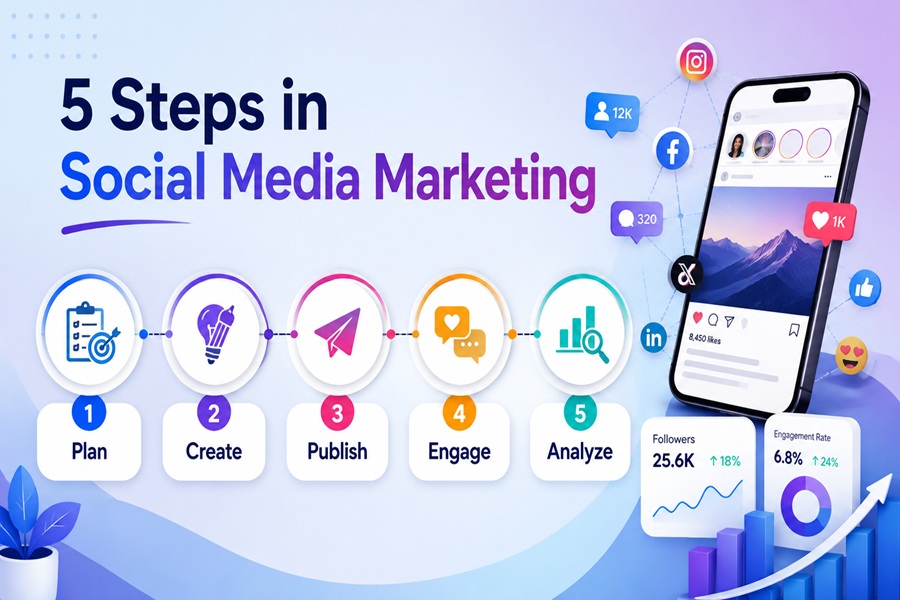
    Quick answer: The 5 steps in social media marketing are: (1) set clear, measurable goals, (2) understand your target audience, (3) choose the right platforms and study competitors, (4) create purposeful content tied to each goal, and (5) measure, learn, and adjust. The point of the framework is simple. Link every post to a business objective instead of posting at random.

    Posting without a plan burns hours and returns nothing. This framework fixes that. Here is each step, what to do inside it, and the mistakes that quietly decide whether it works.

    Step 1: Set clear, measurable goals

    Everything starts with knowing what you want social media to achieve.

    Decide the outcome first. Do you want brand awareness, website traffic, leads, or sales? Then make the goal measurable so you can prove progress.

    Use SMART goals: specific, measurable, achievable, relevant, and time-bound. “Grow followers” is not a goal. “Grow qualified website clicks from Instagram by 20 percent in one quarter” is.

    Tie goals to business outcomes, not vanity metrics. Follower counts do not pay salaries. Reach, leads, and revenue do.

    Map each goal to a funnel stage:

    • Awareness goals build reach and new eyeballs.
    • Consideration goals build trust and engagement.
    • Conversion goals build leads and sales.

    Without clear goals, you cannot measure success or calculate return on investment.

    Step 2: Understand your target audience

    You cannot create content that lands until you know who it is for.

    Build buyer personas from real data, not assumptions. A persona is a short profile of your typical customer, drawn from demographics, interests, and behavior.

    Answer three questions for each persona:

    • Who are they, and where do they spend time online?
    • What problems are they trying to solve?
    • What content do they find genuinely useful?

    Assumptions are expensive. The more your personas reflect real customers, the more your content will convert.

    Step 3: Choose your platforms and study competitors

    Not every platform deserves your time. Pick based on where your buyers actually are.

    Match the platform to the audience and format:

    • Instagram and TikTok: visual and short-form video, younger and consumer audiences.
    • Facebook: broad reach, local businesses, community groups.
    • LinkedIn: B2B, professionals, and decision-makers.
    • YouTube: long-form education and search-driven video.
    • Pinterest: discovery for retail, home, and lifestyle.

    Then run a quick competitive analysis. Look at what similar brands post, what earns engagement, and where the gaps are. You are looking for openings, not a template to copy.

    A helpful extra step here is a social media audit. Review your current profiles, see what has worked, and fix weak spots before you scale.

    Step 4: Create purposeful content tied to each goal

    This is where strategy becomes visible. Every post should serve a goal from Step 1.

    Use content pillars. Pick three or four recurring themes you can sustain, such as education, behind-the-scenes, customer proof, and promotions. Pillars keep your feed consistent and reduce creative burnout for your team.

    Build a content calendar. Plan formats, topics, and posting times in advance so you are never scrambling.

    Test and refine. Try different tones, formats, headlines, and calls to action. Run each test for a set period, then double down on what your audience responds to. Give a content direction at least a few months before judging it.

    Match the format to the platform. A post that works on LinkedIn will rarely work as-is on TikTok.

    Step 5: Measure, learn, and adjust

    Social media is not “set and forget.” The final step feeds back into the first.

    Track the metrics that map to your goals, not just likes. Watch reach, engagement rate, clicks, leads, and conversions.

    Calculate ROI per channel, separately. Combining results hides which platform actually earns its budget. Measure each one on its own.

    Review, then adjust. Keep what works, cut what does not, and update your plan. This is why the framework is a loop, not a straight line. Step 5 sends you back to Step 1 with better information.

    Is it really only 5 steps?

    Five is the core. Some frameworks split them into more, adding a formal audit or a competitor step as its own stage. The substance rarely changes.

    At its heart the process is always: goals, audience, platforms, content, measurement. Whether you count that as five steps or eight, the logic holds.

    What do marketers say actually makes it work?

    Practitioner communities are blunt about where these steps go wrong, and their patterns are worth reading.

    • On Reddit, social media managers repeatedly warn that the most common failure is skipping Step 1. People jump straight to posting, then wonder why nothing converts. Goals first, always.
    • On Quora, marketers stress that audience research beats clever content. A mediocre post aimed at the right people outperforms a brilliant one aimed at nobody.
    • On Medium, experienced managers emphasize the measurement loop. The brands that win are the ones that treat every post as a test, read the data, and adjust, rather than posting on autopilot.

    The shared lesson: the steps are simple, but discipline is rare. Consistency and honest measurement separate results from busywork.

    An insight most “5 steps” articles skip

    Two points rarely make the standard lists, and both change your results.

    Social search is now part of content. People increasingly search inside platforms like TikTok, YouTube, and Instagram the way they once used Google. Writing clear, keyword-aware captions and titles (sometimes called social search optimization) helps your content get discovered long after you post it. Build this into Step 4.

    The framework is circular, not linear. Most articles present five tidy steps and stop. In practice, measurement in Step 5 constantly rewrites your goals, audience understanding, and content in Steps 1 through 4. Treat it as a loop that compounds, and social media stops being a time sink and starts becoming a channel that pays off.

    Frequently asked questions

    What is the first step in social media marketing?

    Setting clear, measurable goals tied to business objectives. Without them you cannot track ROI or know if anything is working.

    How do you measure social media marketing success?

    Track metrics that map to your goals, such as reach, engagement, clicks, leads, and conversions. Calculate ROI for each channel separately rather than combining them.

    How many platforms should a beginner use?

    One or two, chosen by where your audience actually spends time. Going deep on a couple beats spreading thin across many.

    How long before social media marketing shows results?

    Give a content direction at least a few months. Social builds on consistency, and short tests rarely reveal what truly works.

    Do I need a strategy document?

    Yes. A short written plan covering goals, personas, platforms, content pillars, and metrics turns random posting into a repeatable system.