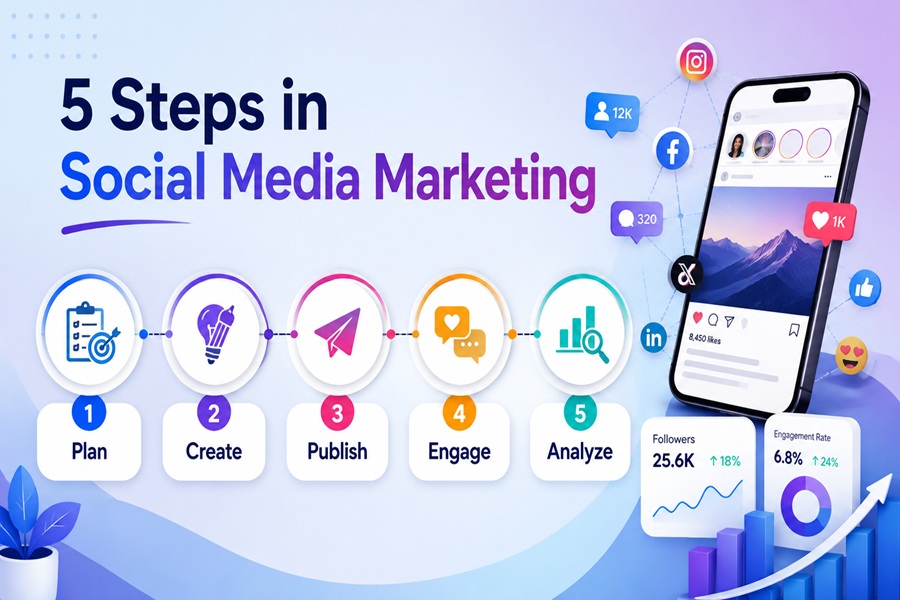
Quick answer: The 5 steps in social media marketing are: (1) set clear, measurable goals, (2) understand your target audience, (3) choose the right platforms and study competitors, (4) create purposeful content tied to each goal, and (5) measure, learn, and adjust. The point of the framework is simple. Link every post to a business objective instead of posting at random.
Posting without a plan burns hours and returns nothing. This framework fixes that. Here is each step, what to do inside it, and the mistakes that quietly decide whether it works.
Step 1: Set clear, measurable goals
Everything starts with knowing what you want social media to achieve.
Decide the outcome first. Do you want brand awareness, website traffic, leads, or sales? Then make the goal measurable so you can prove progress.
Use SMART goals: specific, measurable, achievable, relevant, and time-bound. “Grow followers” is not a goal. “Grow qualified website clicks from Instagram by 20 percent in one quarter” is.
Tie goals to business outcomes, not vanity metrics. Follower counts do not pay salaries. Reach, leads, and revenue do.
Map each goal to a funnel stage:
- Awareness goals build reach and new eyeballs.
- Consideration goals build trust and engagement.
- Conversion goals build leads and sales.
Without clear goals, you cannot measure success or calculate return on investment.
Step 2: Understand your target audience
You cannot create content that lands until you know who it is for.
Build buyer personas from real data, not assumptions. A persona is a short profile of your typical customer, drawn from demographics, interests, and behavior.
Answer three questions for each persona:
- Who are they, and where do they spend time online?
- What problems are they trying to solve?
- What content do they find genuinely useful?
Assumptions are expensive. The more your personas reflect real customers, the more your content will convert.
Step 3: Choose your platforms and study competitors
Not every platform deserves your time. Pick based on where your buyers actually are.
Match the platform to the audience and format:
- Instagram and TikTok: visual and short-form video, younger and consumer audiences.
- Facebook: broad reach, local businesses, community groups.
- LinkedIn: B2B, professionals, and decision-makers.
- YouTube: long-form education and search-driven video.
- Pinterest: discovery for retail, home, and lifestyle.
Then run a quick competitive analysis. Look at what similar brands post, what earns engagement, and where the gaps are. You are looking for openings, not a template to copy.
A helpful extra step here is a social media audit. Review your current profiles, see what has worked, and fix weak spots before you scale.
Step 4: Create purposeful content tied to each goal
This is where strategy becomes visible. Every post should serve a goal from Step 1.
Use content pillars. Pick three or four recurring themes you can sustain, such as education, behind-the-scenes, customer proof, and promotions. Pillars keep your feed consistent and reduce creative burnout for your team.
Build a content calendar. Plan formats, topics, and posting times in advance so you are never scrambling.
Test and refine. Try different tones, formats, headlines, and calls to action. Run each test for a set period, then double down on what your audience responds to. Give a content direction at least a few months before judging it.
Match the format to the platform. A post that works on LinkedIn will rarely work as-is on TikTok.
Step 5: Measure, learn, and adjust
Social media is not “set and forget.” The final step feeds back into the first.
Track the metrics that map to your goals, not just likes. Watch reach, engagement rate, clicks, leads, and conversions.
Calculate ROI per channel, separately. Combining results hides which platform actually earns its budget. Measure each one on its own.
Review, then adjust. Keep what works, cut what does not, and update your plan. This is why the framework is a loop, not a straight line. Step 5 sends you back to Step 1 with better information.
Is it really only 5 steps?
Five is the core. Some frameworks split them into more, adding a formal audit or a competitor step as its own stage. The substance rarely changes.
At its heart the process is always: goals, audience, platforms, content, measurement. Whether you count that as five steps or eight, the logic holds.
What do marketers say actually makes it work?
Practitioner communities are blunt about where these steps go wrong, and their patterns are worth reading.
- On Reddit, social media managers repeatedly warn that the most common failure is skipping Step 1. People jump straight to posting, then wonder why nothing converts. Goals first, always.
- On Quora, marketers stress that audience research beats clever content. A mediocre post aimed at the right people outperforms a brilliant one aimed at nobody.
- On Medium, experienced managers emphasize the measurement loop. The brands that win are the ones that treat every post as a test, read the data, and adjust, rather than posting on autopilot.
The shared lesson: the steps are simple, but discipline is rare. Consistency and honest measurement separate results from busywork.
An insight most “5 steps” articles skip
Two points rarely make the standard lists, and both change your results.
Social search is now part of content. People increasingly search inside platforms like TikTok, YouTube, and Instagram the way they once used Google. Writing clear, keyword-aware captions and titles (sometimes called social search optimization) helps your content get discovered long after you post it. Build this into Step 4.
The framework is circular, not linear. Most articles present five tidy steps and stop. In practice, measurement in Step 5 constantly rewrites your goals, audience understanding, and content in Steps 1 through 4. Treat it as a loop that compounds, and social media stops being a time sink and starts becoming a channel that pays off.
Frequently asked questions
What is the first step in social media marketing?
Setting clear, measurable goals tied to business objectives. Without them you cannot track ROI or know if anything is working.
How do you measure social media marketing success?
Track metrics that map to your goals, such as reach, engagement, clicks, leads, and conversions. Calculate ROI for each channel separately rather than combining them.
How many platforms should a beginner use?
One or two, chosen by where your audience actually spends time. Going deep on a couple beats spreading thin across many.
How long before social media marketing shows results?
Give a content direction at least a few months. Social builds on consistency, and short tests rarely reveal what truly works.
Do I need a strategy document?
Yes. A short written plan covering goals, personas, platforms, content pillars, and metrics turns random posting into a repeatable system.