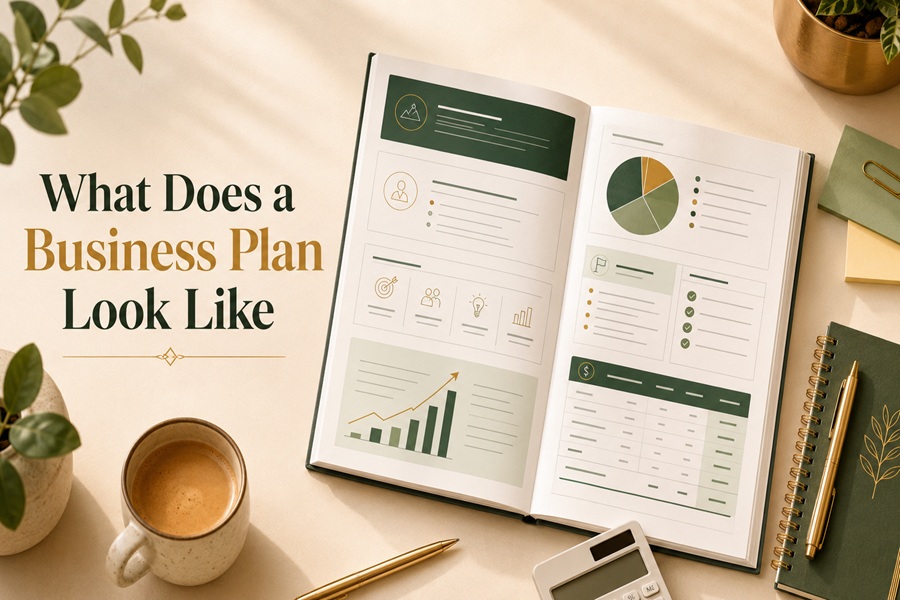
A business plan looks like a structured document, usually 10 to 30 pages, built from a standard set of sections: an executive summary, company description, products and services, market analysis, competition, marketing and sales, operations and management, financial projections, and an appendix. It opens with a cover page and table of contents, uses clean formatting, and leads with the executive summary even though you write that part last. Lenders and investors expect this backbone, so covering these sections clearly is what makes a plan look complete.
Here is the full anatomy, section by section, plus format variations and the formatting details that make a plan look professional.
What is a business plan, in one line?
A business plan is a written roadmap that spells out your goals, strategy, and financial forecasts. It tells investors, lenders, and partners where you are headed and how you will get there.
It is not a cookie-cutter document. The structure stays consistent, but the details vary with every business.
What sections does a business plan include?
Most serious plans follow the same backbone. Here is the standard outline and roughly how long each part runs.
| Section | What it covers | Typical length |
|---|---|---|
| Executive summary | The whole plan in brief, written last | 1 page |
| Company description | What you do, structure, mission, history | 0.5 to 1 page |
| Products and services | What you sell and why it matters | 1 to 2 pages |
| Market analysis | Target market, size, trends | 2 to 3 pages |
| Competition | Rivals and your edge | 1 to 2 pages |
| Marketing and sales | How you reach and win customers | 2 to 3 pages |
| Operations and management | How the business runs and who runs it | 1 to 2 pages |
| Financial plan and projections | Forecasts, cash flow, funding needs | 2 to 3 pages |
| Appendix | Supporting documents and detail | As needed |
Cover these areas clearly and most banks and investors will recognize your plan as complete.
Section 1: Executive summary
This is the first thing readers see and the last thing you write.
It condenses the entire plan into a single page: what your business does, the opportunity, your edge, and what you are asking for. If you are seeking funding, state how much and what type.
Many investors decide whether to keep reading based on this page alone. Make it sharp.
Section 2: Company description
Here you answer a simple question: what is your business?
Include your legal structure (sole proprietorship, LLC, or corporation), ownership and equity split, a brief history if you have started, your location and target market, and your mission and vision. Keep it tight and concrete.
Section 3: Products and services
Describe what you sell and the problem it solves. Explain what makes it different and why customers will choose it.
Focus on the customer benefit, not just features. Even great products do not sell themselves, so make the value obvious.
Section 4: Market analysis
This is where your research proves the opportunity is real.
Cover your target market, its size, and the trends shaping it. Show you understand who your customers are and how the market is moving. Charts help readers absorb this fast.
Section 5: Competition
Show that you know the landscape. List your main competitors and, more importantly, explain your competitive edge.
Investors want to see that you understand who you are up against and why you can win.
Section 6: Marketing and sales
Explain how you will attract and convert customers. Cover your channels, pricing, and sales process.
This section connects the opportunity to actual revenue. Be specific about how customers will find you and why they will buy.
Section 7: Operations and management
Describe how the business runs day to day and who runs it.
Highlight your structure and key team members, along with their relevant experience. Investors bet on people as much as ideas, so make the team credible.
Section 8: Financial plan and projections
For many readers this is the heart of the plan. Some investors turn here first.
Include a sales forecast, profit and loss projection, cash flow forecast, and balance sheet, plus your funding needs. If you are seeking a loan, make sure the projections support repayment. Define whether you want debt or equity funding.
Section 9: Appendix
This holds the supporting evidence: detailed financials, resumes, contracts, licenses, permits, market research, and any renderings.
It substantiates the claims made earlier without cluttering the main plan.
Traditional or lean: which format should you use?
The right format depends on your purpose and stage. There are two main styles.
| Format | Length | Best for |
|---|---|---|
| Traditional plan | 10+ structured sections, longer | Securing funding, loans, detailed strategy |
| Lean startup plan | Short, one to a few pages | Early startups iterating quickly |
Match the format to the audience. A bank or investor expects the traditional plan. A founder testing a model may only need the lean version at first.
What does a business plan physically look like?
Beyond the sections, presentation signals professionalism. A polished plan tends to share these traits.
- Cover page with the company name, so it is identifiable in a stack of others.
- Table of contents so readers jump straight to the section they want.
- Clean formatting: a standard font like Arial or Times New Roman at 12 point, one-inch margins.
- Page numbers and the company name in the header or footer.
- Charts and visuals wherever they make numbers easier to grasp.
One caution: do not confuse looks with substance. A plainly formatted plan with strong financials beats a beautiful plan with weak numbers every time.
What do founders say about writing one?
Practitioner communities offer useful reality checks.
- On Reddit, founders repeatedly warn against overbuilding the plan before testing the business. The advice is often to start lean, validate the model, then expand into a full plan when raising money.
- On Quora, entrepreneurs stress that the financial section carries the most weight with lenders. Vague numbers sink otherwise good plans.
- On Medium, people who have raised funding emphasize the executive summary. If that one page does not land, the rest may never get read.
The shared theme: get the numbers right, nail the summary, and match the depth to your purpose.
Frequently asked questions
How long should a business plan be? A traditional plan usually runs 10 to 30 pages plus an appendix. A lean startup plan can be one to a few pages.
What are the main sections of a business plan? Executive summary, company description, products and services, market analysis, competition, marketing and sales, operations and management, financial projections, and appendix.
Which section is most important? The executive summary grabs attention, and the financial projections carry the most weight with lenders. Both deserve extra care.
Do I write the executive summary first? No. Write it last, after the rest of the plan exists, so it accurately reflects the whole.
Do I need a business plan to get a loan? Usually yes. Lenders, investors, and even some landlords and vendors expect a structured plan showing you understand your numbers, market, and risks.