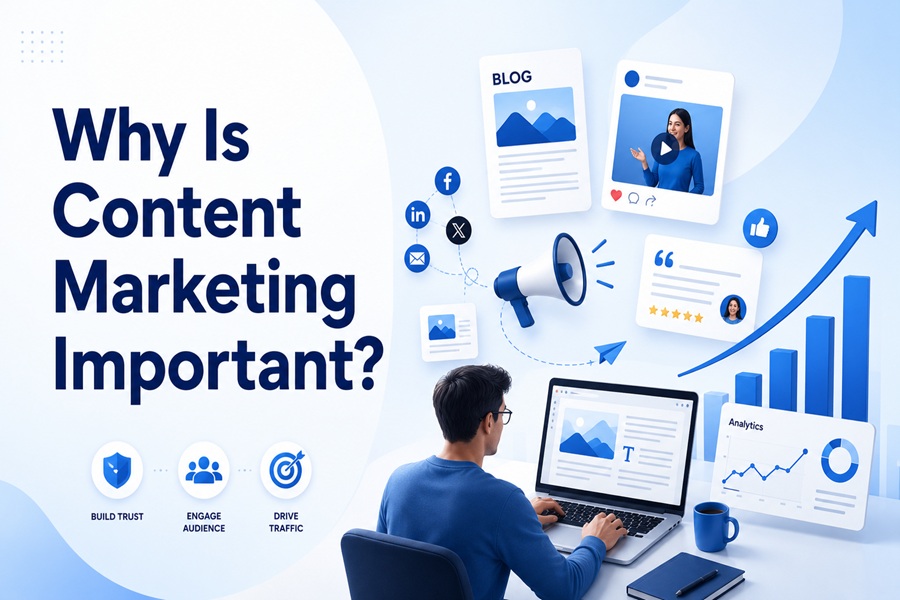
Quick answer: Content marketing is important because it builds trust and authority, costs far less than paid advertising, and keeps working long after you publish. It generates about three times more leads per dollar than traditional advertising at roughly 62 percent lower cost, and most consumers prefer learning about a company through helpful content rather than ads. Unlike paid ads that stop the moment you stop paying, content compounds into a lasting asset.
Here is the full case: the benefits, the data behind them, and the mistakes that stop content from paying off.
What is content marketing, in one line?
Content marketing is the practice of creating and sharing useful content, such as blog posts, videos, guides, and case studies, to attract, educate, and win customers, instead of interrupting them with ads.
The goal is not to sell in every sentence. It is to be genuinely helpful, so people trust you before they ever buy.
Why does content marketing matter so much?
Here are the core reasons, each backed by how buyers actually behave.
It builds trust and authority. When you consistently share helpful content, people see you as an expert. It is far easier to win a client who already trusts you before the first call. Content authenticity matters to roughly 90 percent of consumers when they decide which brands to support.
Buyers prefer it to ads. Around 70 percent of people would rather learn about a company through articles than through traditional advertising. Content meets people where their attention already is.
It costs less and returns more. Content marketing generates about three times more leads per dollar than traditional advertising, at roughly 62 percent lower cost. Good content keeps working for months without repeat ad spend.
It drives organic traffic. Businesses that publish blog content regularly average around 55 percent more visitors than those that do not. That traffic arrives without paying per click.
It influences sales directly. Nearly 90 percent of marketers say case studies and customer testimonials are among the most effective formats for influencing buying decisions.
What are the main benefits at a glance?
| Benefit | Why it matters |
|---|---|
| Authority | Consistent, helpful content makes you the go-to expert |
| Trust | Warms up buyers before they ever contact you |
| Cost-efficiency | Cheaper leads than ads, with lasting value |
| Organic visibility | Ranks in search and pulls in traffic for free |
| Lead generation | More leads per dollar than paid channels |
| Customer retention | Educates and re-engages existing customers |
| Sales influence | Case studies and proof move buyers to decide |
Is content marketing a short-term or long-term play?
It is a long-term investment that compounds. This is the point most businesses miss.
Paid ads are a switch. Turn them off and the traffic stops. Content is an asset. Each piece keeps earning visits, leads, and trust long after you publish.
The most significant returns typically show up around nine to twelve months in, then accelerate as your library of content grows. Early impatience is why many teams quit right before the payoff.
Why do some content programs fail?
Content does not work automatically. These are the common failure points, and each has a fix.
- No distribution. Even excellent content underperforms if nobody sees it. Promote every piece across the channels your audience uses.
- Chasing vanity metrics. Page views and likes feel good but do not pay the bills. Track leads and revenue instead.
- No ROI measurement. Teams that measure content ROI are far more likely to grow their returns year over year. Measurement is what turns content from a “nice to have” into a revenue engine.
- Wrong format for the goal. A blog post, a video, and a case study each suit different objectives. Match the format to the outcome you want.
- Quitting too early. Content compounds. Judging it after a few weeks guarantees you never see the return.
How is AI changing content marketing?
AI has become a genuine multiplier, and ignoring it now means falling behind.
Teams using AI in their workflow report delivering content dramatically faster, with some studies citing content velocity gains of over 80 percent. That speed compresses time to market, tightens feedback loops, and lets teams test more variations.
The catch: AI accelerates production, but strategy, originality, and human judgment still decide whether content actually resonates. Faster bad content is still bad content.
What about content and AI search?
Here is an insight most “why content matters” articles still miss. Search itself is changing.
AI-powered answers and overviews now pull directly from well-structured, trustworthy content. If your content clearly answers real questions, it can be surfaced and quoted in those answers. If it does not, a competitor’s will be.
This raises the stakes for content quality and structure. Content is no longer just about ranking a page. It is about being the source an AI trusts enough to cite.
What do marketers say from experience?
Practitioner communities reinforce the data with hard-won lessons.
- On Reddit, marketers repeatedly stress consistency over cleverness. The people who win are not the ones with the flashiest single post, but the ones who publish useful content steadily for months.
- On Quora, business owners describe content as their cheapest long-term salesperson. One good guide keeps answering the same buyer question and closing the same objection, indefinitely.
- On Medium, experienced content leads warn against the vanity-metric trap. They tie every piece to a business goal and measure ROI, or they cut it. That discipline is what separates a content program from a content hobby.
The shared theme: helpful, consistent, measured content compounds. Random posting does not.
Two points rarely make the standard case for content, and both change how you invest.
Content is an owned asset, not a rented one. Ads rent attention. Content builds equity. Every published piece adds to a library that keeps working, which is why the returns compound rather than reset each month.
Structure is now part of value. As AI answers reshape discovery, content that is clear, well-organized, and genuinely authoritative gets surfaced and cited. Writing to be the trusted source, not just to rank, is the new edge.
Frequently asked questions
Why is content marketing important for small businesses?
It gives smaller players a way to compete on expertise rather than ad budget. Helpful content builds trust and pulls in organic traffic without paying per click.
Does content marketing actually drive sales?
Yes. It warms up buyers, answers objections, and supplies proof through case studies and testimonials, which most marketers rate among the most effective formats for influencing decisions.
How long until content marketing works?
Expect meaningful returns around nine to twelve months in, accelerating as your content library grows. It rewards consistency.
Is content marketing cheaper than advertising?
Generally yes. It produces more leads per dollar than traditional advertising at a lower cost, and each piece keeps working after publication.
How do you measure content marketing success?
Track leads, conversions, and revenue tied to content, not just page views and likes. Teams that measure ROI are far more likely to improve returns over time.